Canva — Organisations
Systems design, Product strategy, Enterprise and education
Canva grew up selling to one team at a time. A school district, a university or a global company is dozens or hundreds of teams, and it expects to sign once, log in once, and run its brand from one place.
I originated the organisation model at Canva: an umbrella above teams that holds identity, brand, billing and administration, while each team keeps its own work. Canva Enterprise, Canva for Schools and Districts and Canva for Campus are built on it.
- Role
- Originator and product owner, Organizations
- Team
- Organizations, People Management, Revenue Platform, User Platform, Sales, Education
- Timeline
- 2022–2025
- Platform
- Web
2,800
organisations by June 2024
22.4M
users inside organisations
1,000+
districts onboarded in six months
The problem
Big customers had two bad options
Before organisations, a customer with many parts had two ways to fit into Canva, and neither worked.
Option one
Put everyone in one team
Everyone can collaborate, but nobody has autonomy, and every school sees every other school's work.
Option two
Give every part its own team
Each part gets autonomy, but the teams are islands, with SSO, billing and admins set up one team at a time.
The rule that made option two so painful was written into the product.
Teams can't collaborate with other teams, even if your organization owns them both.
An older workaround, the "managing brand", loosely linked teams, but only Canva staff could configure it and it couldn't carry enterprise features.
My role
I originated the model and owned Cycle 1
I proposed replacing managed teams and managing brands with a real multi-team organisation, and wrote the five-year vision and two-to-three-year roadmap. Each release had to be useful on its own: skateboard, bicycle, car.
I was product owner on Organizations Cycle 1 with Lindsay Reno, and design lead on the structure, one of Canva's early P0 projects.
Partners
People Management
Roles, people and groups.
Partners
Revenue Platform
One subscription and invoice.
Partners
User Platform
Identity and SSO.
Partners
Sales
Customers and rollouts.
Partners
Education
Districts, campuses and ministries.
Partners
Brand Experience
Brand kits above a team.
The model
An organisation is an umbrella, not a bigger team
The organisation owns everything decided once, teams own the work, and groups organise people inside a team.
The structure
Decide it once at the top, do the work in the teams
Organisation
- Verified domains
- SSO and provisioning
- Shared brand kits
- Permissions and controls
- One subscription, one invoice
- Organisation administrators
Teams
- Designs, folders and templates
- Team brand kits
- Team administrators
- A Team ID for SSO
Groups
- People who work together
- Sharing inside a team
Four principles kept every team building on it aligned.
Follow the hierarchy
The organisation sits above its teams, everywhere.
Reuse pages
An organisation page is a team page with a wider scope.
Feel the same at every level
Know a team, know the organisation.
Manage anything from the top
Anything managed in a team can be managed from above.
The questions under the structure
Decision
Where does a person belong?
The identity provider sends a Team ID at sign-in, so people land in the right team first time.
Decision
Who can do what?
Organisation admins manage any team. Team admins run their own, inside the organisation's rules.
Decision
When should a new team exist?
Rarely. The product asks "Are you sure you need another team?" and points people to groups.
Decision
Is a district the same as a company?
No. Classifying it as a district, campus or enterprise decides its teams and rules.
Decision
What can we not do yet?
A person could only be in 100 teams, and removing a team was too risky to self-serve. We designed around both.
The vision
Showing what an organisation could be
Before anything was built, I made the vision concrete with a state education department, its schools as teams.
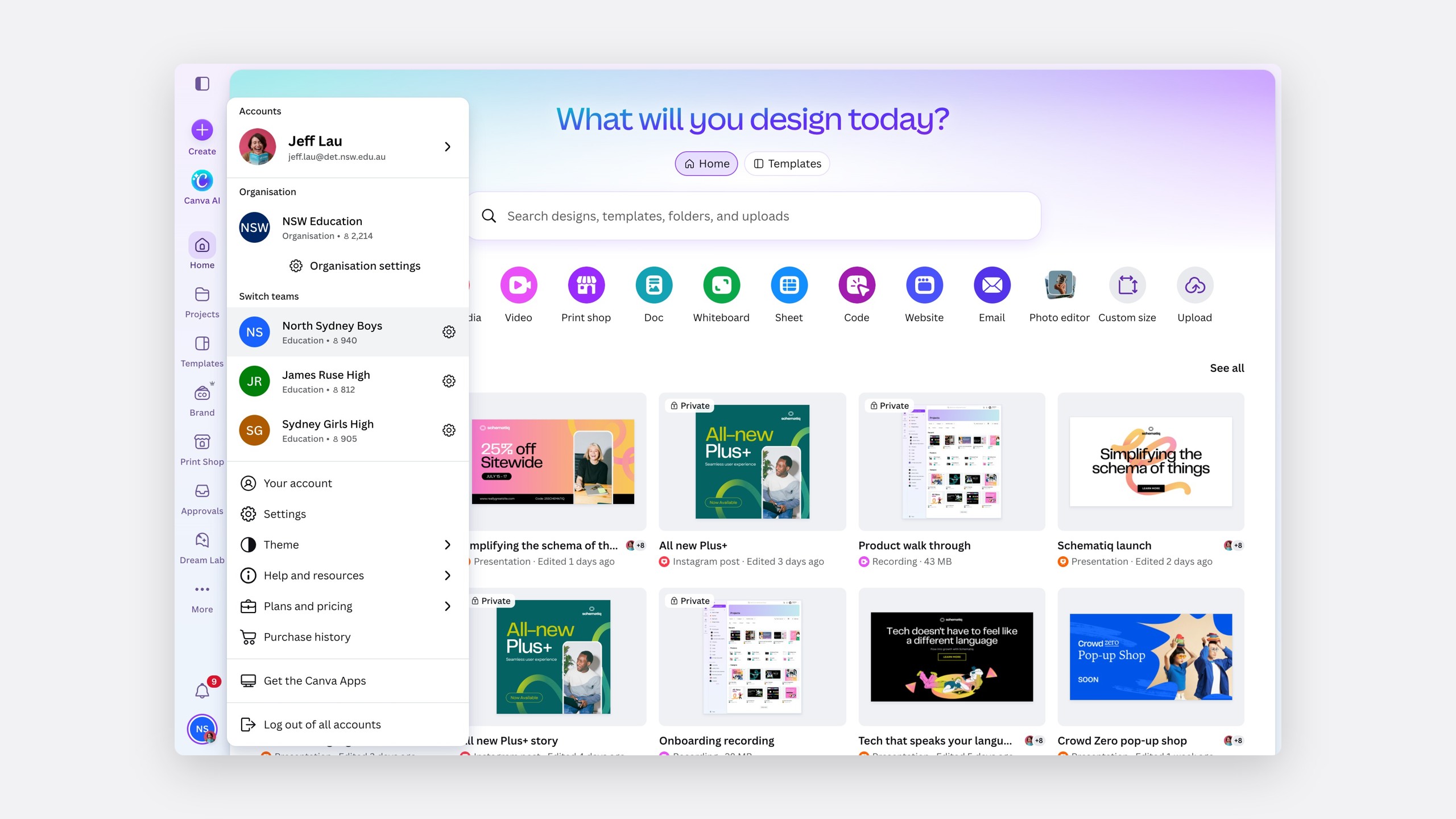
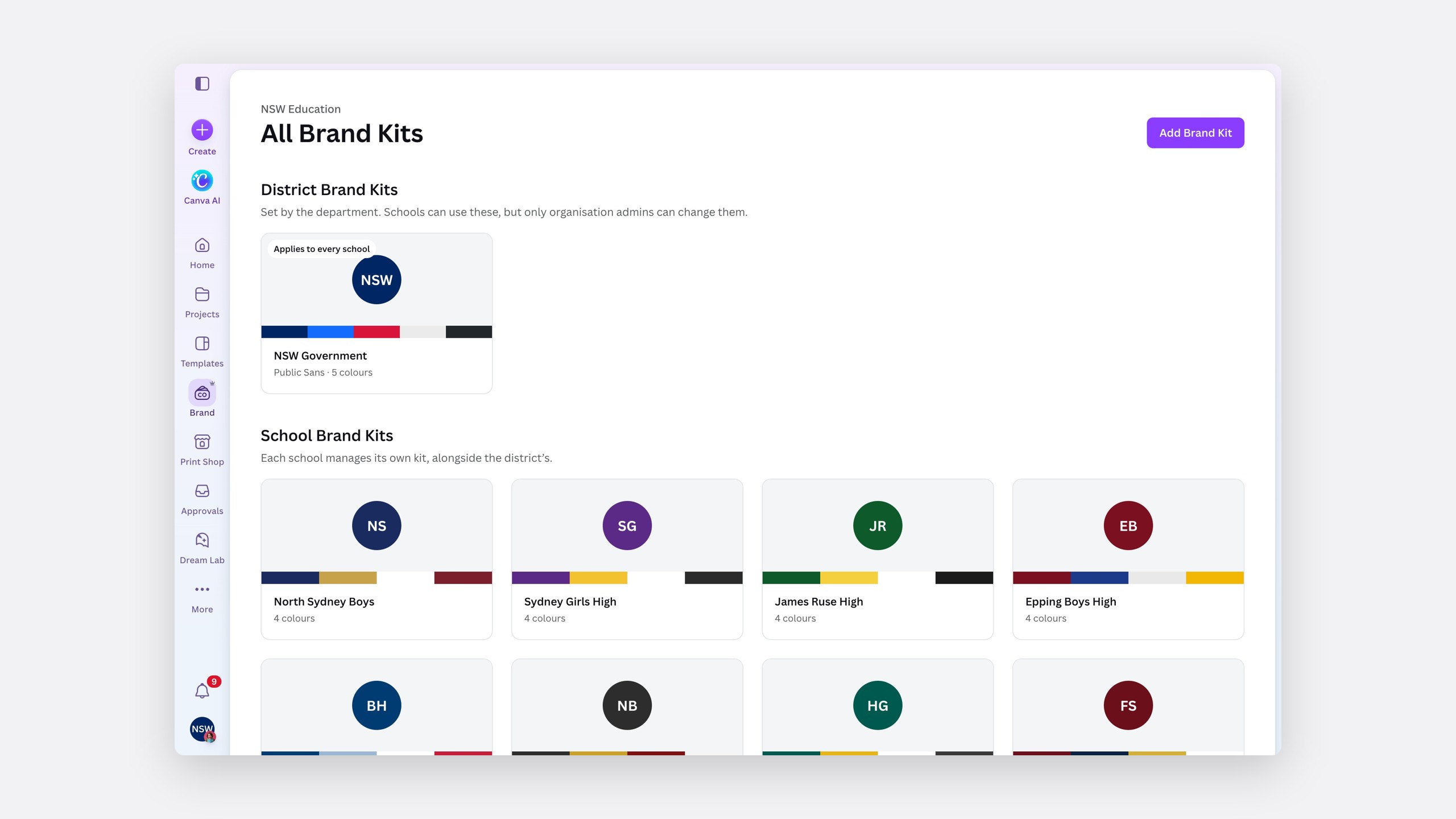
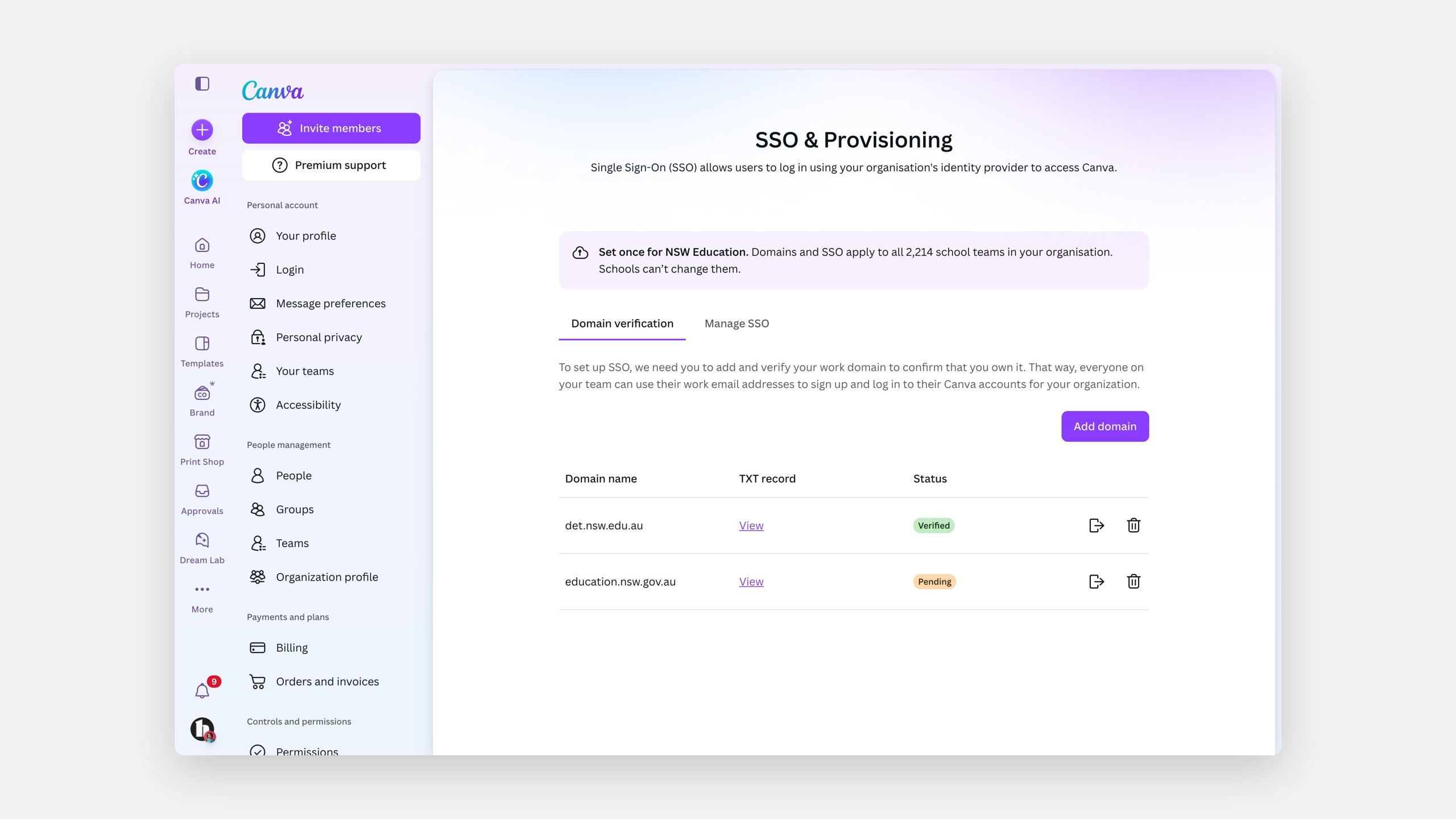
The organisation in the team switcher, with settings for the whole organisation
Cycle 1
Test the layer above teams first
We tested with a fictional organisation, Orange Co. Participants understood they belonged to it and could move between teams, and a plain "Manage" entry made settings findable.
Usability testing, Organizations Cycle 1
People understood they belonged to an organisation
12.5% → 100%first-time success finding organisation settings, after adding Manage
75% preferred the organisation at the top of the switcher.6 of 8 participants.
93.75% could switch teams to manage another one.15 of 16, and all of them understood they had moved.
100% opened organisation settings in a later round, up from 62.5%.Across 24 sessions.
Four weeks instead of two years
About 50 requests a week for organisation or team changes were waiting on Sales or the Canva Help Team. A complete organisation page would take more than two years. Quick links took four weeks and removed most of the waiting.
The full build
2+ years
A complete organisation page.
What we shipped first
4 weeks
Quick links, team search and filters, Team IDs and administrators.
The organisation profile
Team profile becomes Organization profile
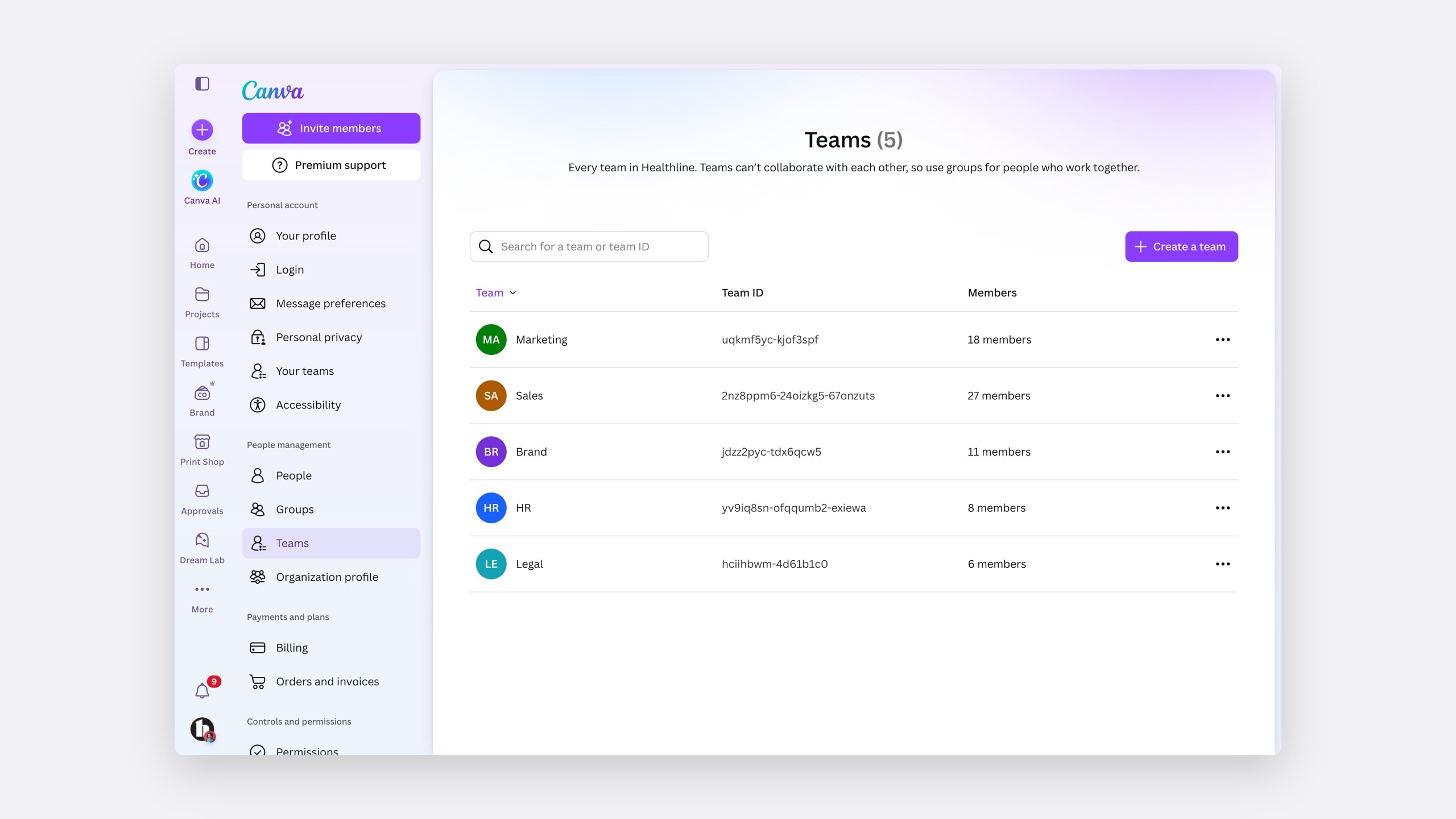
As every enterprise customer became an organisation, the organisation had to own identity. For an organisation admin, Team profile becomes Organization profile.
Organization profile
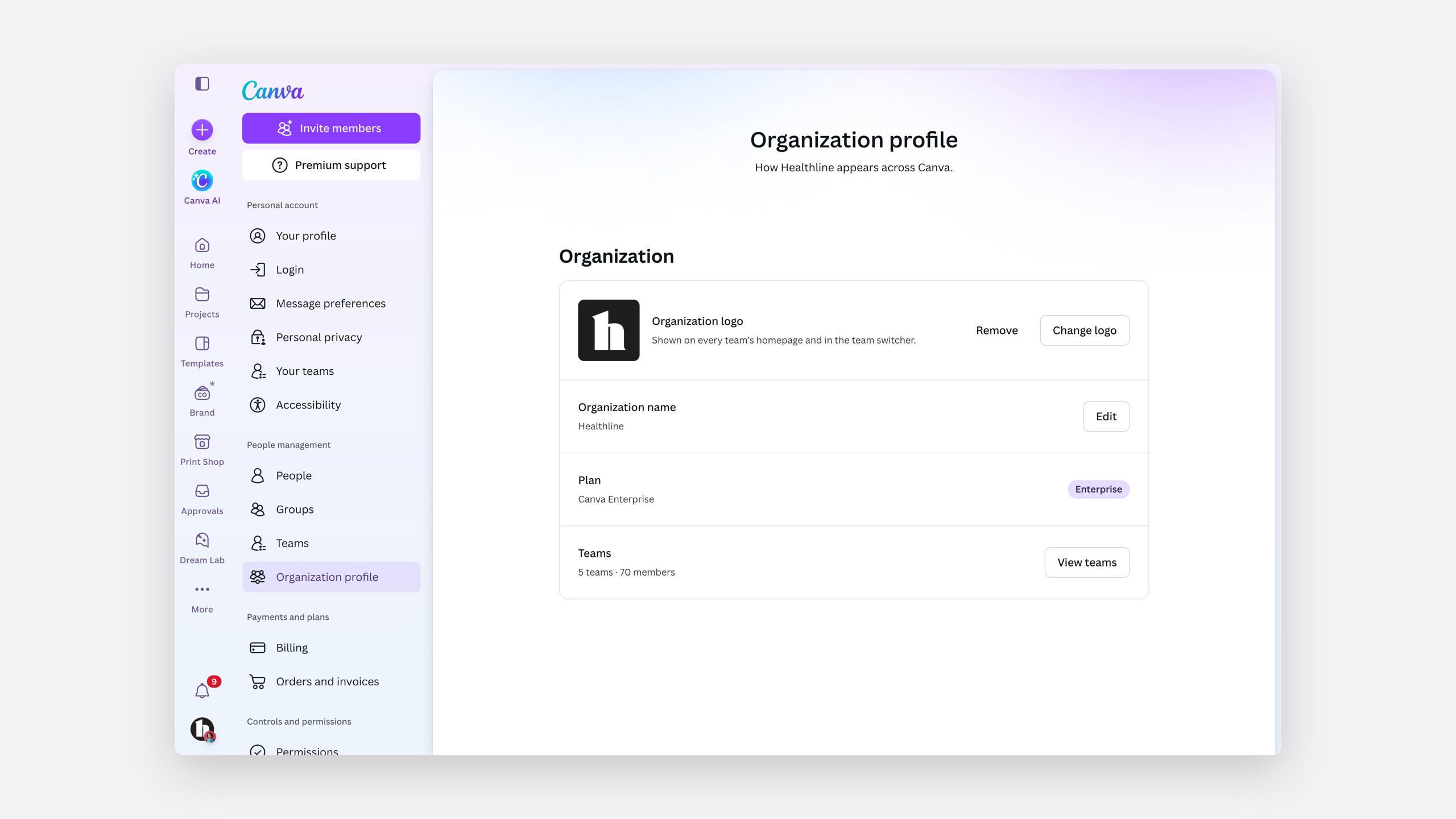
Teams are listed with their Team IDs and admins, with the collaboration rule right above them.
Teams in the organisation
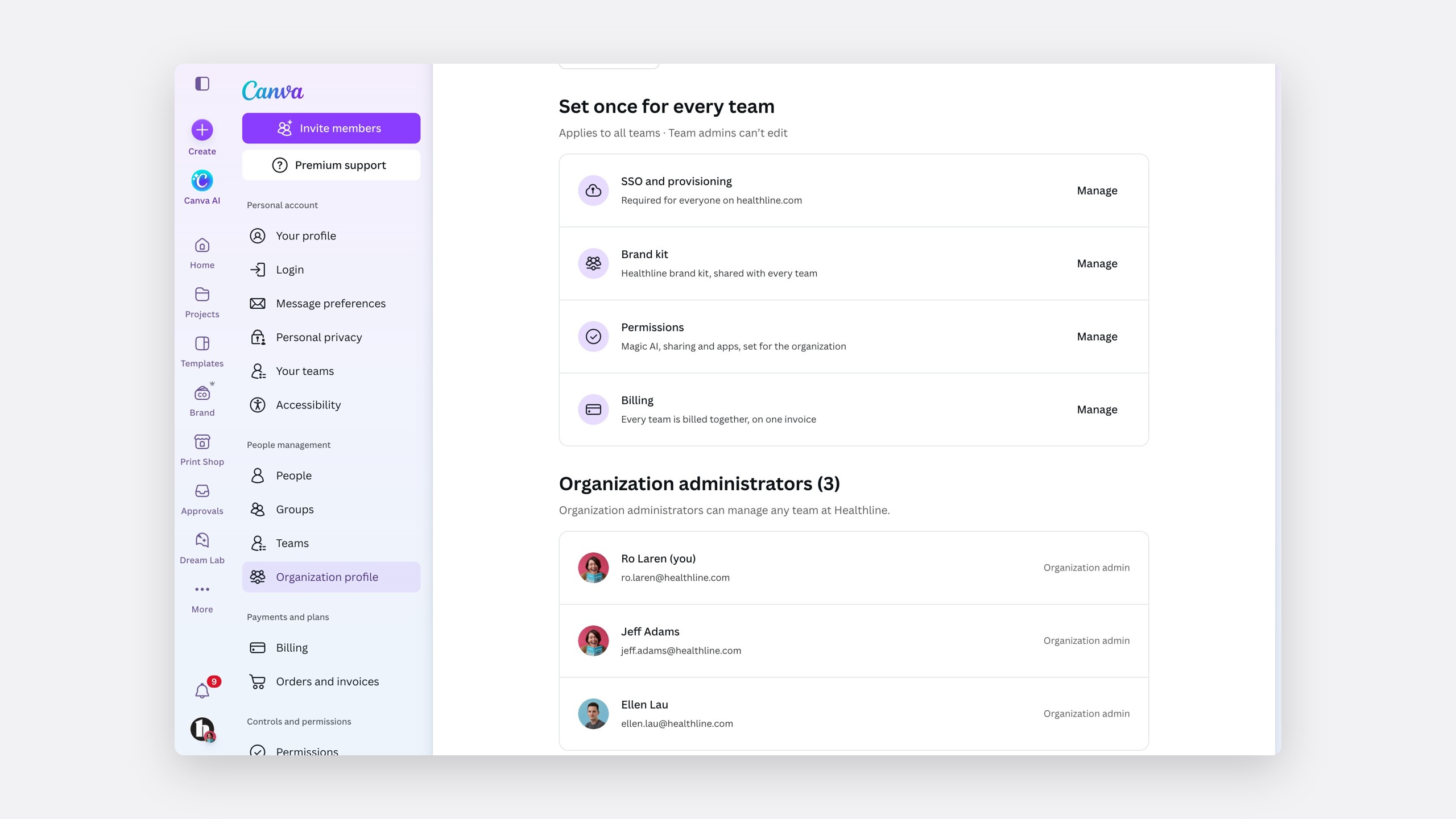
Below sit SSO, the brand kit, permissions and billing, which team admins can see but not change.
Set once for every team
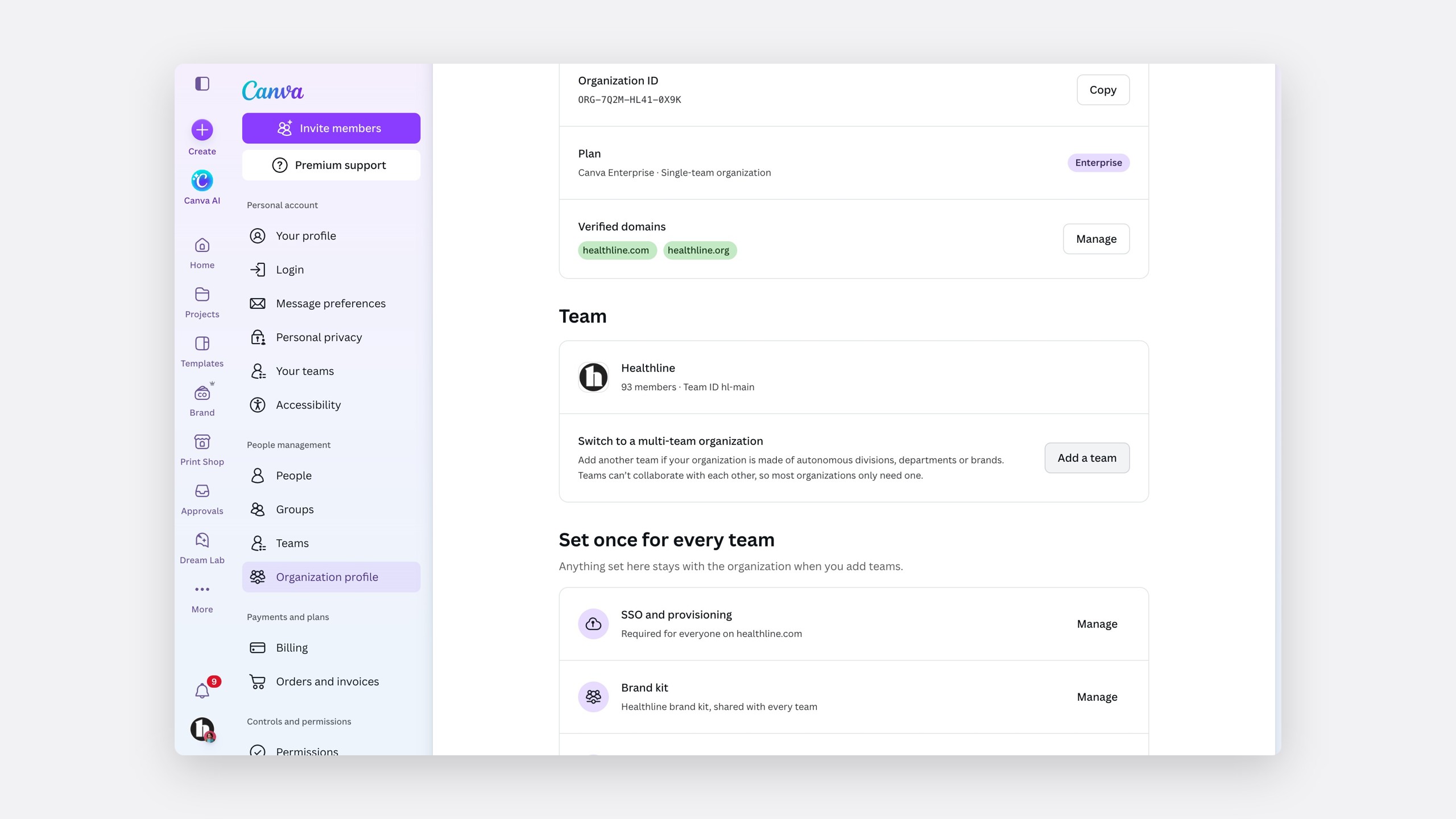
Most organisations have one team
In that case the organisation and its team share one profile, and adding a second team is one button.
A single-team organisation
What it unlocked
One structure, three products
Classified differently, the same structure became three products.
Canva Enterprise
Launched in May 2024 for multi-team organisations. Canva says 95% of the Fortune 500 use it.
Canva for Schools and Districts
Every school is a team. Canva Education reaches 16,000 districts and 800,000 schools.
Canva for Campus
Faculties are teams. 93 campuses adopted it after the September 2023 launch.
It is also the floor for Flip the Switch, Identity and SSO and the settings glow-up.
The impact
Institutions could sign once
The model let Canva onboard more than 1,000 districts in six months, and Indonesia's national education system, with more than 10 million students. By June 2024 there were 2,800 organisations, with 22.4 million users and $6.0 million in ARR, including HSBC, Amazon, Netflix, the Walt Disney Company, Atlassian and Meta.
- 2,800
Organisations by June 2024
- 22.4M
Users inside organisations
- 1,000+
Districts onboarded in six months
- 10M+
Students in Indonesia's education system
Reflection
Structure is the product nobody sees
People notice an organisation only when they log in once and land in the right team. The best compliment was that admins stopped asking how it worked.
If I did it again, I would classify organisations by type from the first release, because every later project had to work it back in.